
Executive Summary
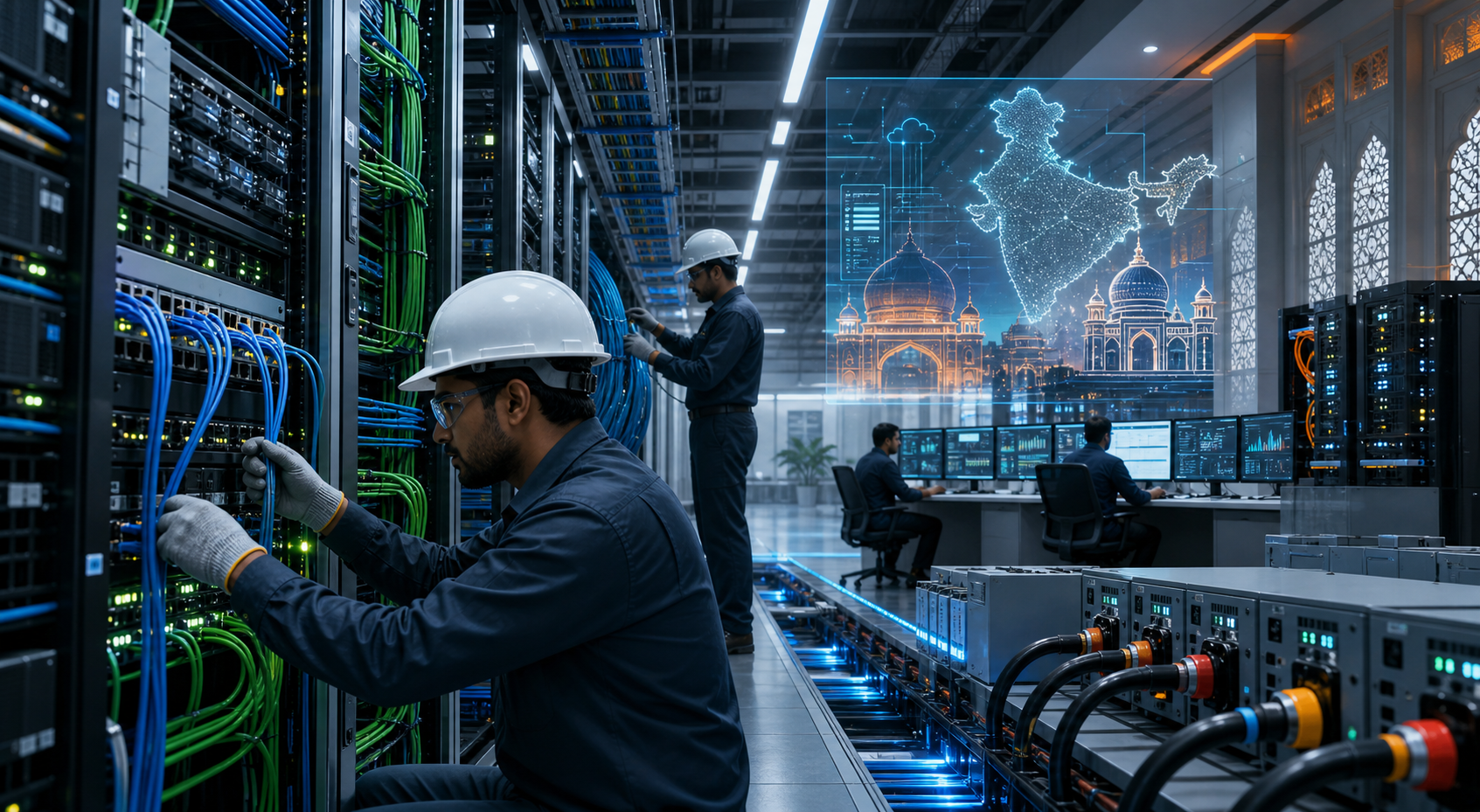
The current AI boom is usually discussed through models, chips, and applications. But every serious AI system depends on a less glamorous layer: data centers, networking, power distribution, structured cabling, secure facilities, cooling systems, water planning, edge infrastructure, and managed operations.
A recent Financial Express market report highlighted two listed companies, Dynacons Systems & Solutions and Black Box, as examples of businesses positioned around India's data-center and AI-infrastructure expansion. The article frames the opportunity around a multi-year data-center boom and a reported combined order book of roughly Rs 11,000 crore.
A separate Economic Times report on Nikhil Kamath's water thesis adds an important constraint: several of India's fastest-growing sectors, including data centers, are water-intensive and expanding in regions already facing water stress. That means AI infrastructure is not only a compute opportunity. It is also a power, cooling, water, and sustainability challenge.
This case study does not provide investment advice. Instead, it uses the news as a teaching case: how does AI demand translate into real infrastructure work, and why do systems integrators, cooling specialists, and resource-efficiency providers become strategically important when a country scales AI compute?
TL;DR
- AI is not only a software story. It is also a facilities, power, networking, and integration story.
- India is seeing rapid demand for data-center capacity from cloud, AI, BFSI, telecom, SaaS, enterprise digitization, and sovereign compute needs.
- A newer water-risk lens makes the thesis stronger: AI data centers also create demand for cooling optimization, water measurement, wastewater reuse, and sustainable facility design.
- Dynacons and Black Box represent two different infrastructure roles: domestic IT/cloud integration and global digital-infrastructure deployment.
- The opportunity is large, but execution risk is real: margins, working capital, order conversion, competitive pressure, and technology cycles all matter.
- For students and builders, the key lesson is to study the AI infrastructure stack, not just the AI model layer.
What Happened
Financial Express reported on June 24, 2026 that India's data-center growth is creating opportunities for companies that provide IT infrastructure, cloud services, networking, and digital-infrastructure deployment. The article specifically discussed:
- Dynacons Systems & Solutions, an Indian IT infrastructure and cloud services company.
- Black Box, a digital-infrastructure and connectivity solutions company with global enterprise exposure.
The report connected these companies to a broader thesis: as AI adoption grows, India needs more compute capacity, more data-center infrastructure, and more enterprise-grade integration work.
Economic Times separately reported on Nikhil Kamath's argument that India's next major opportunity may come from water measurement, management, recycling, and conservation. His observation is relevant here because data centers are one of the growth sectors that require continuous cooling and can add pressure in water-stressed regions.
The useful research question is not "which stock should someone buy?" The better question is:
If India wants to scale AI, who builds and maintains the physical, operational, and resource-efficient layer that makes AI possible?
Why Data Centers Matter For AI
AI workloads are infrastructure-heavy. Training, fine-tuning, inference, retrieval systems, analytics, video generation, and enterprise copilots all consume compute, storage, and network capacity.
A model may be the visible product, but behind it sits a stack:
Applications
AI models
GPU/accelerator clusters
Servers and storage
High-speed networking
Power and cooling
Water measurement and reuse
Data-center facilities
Security and operations
Connectivity to users and enterprises
If any layer is weak, the AI product suffers.
Common failure points include:
- slow inference because networking is underbuilt
- downtime because power redundancy is weak
- site risk because cooling and water availability are poorly planned
- high cloud bills because infrastructure is poorly optimized
- security risk because facility and network access are not controlled
- delayed AI deployment because enterprise systems are not integrated
- poor scalability because data architecture was not designed for AI workloads
This is why AI adoption creates demand for data-center specialists, cloud integrators, network engineers, cybersecurity providers, cooling specialists, water-efficiency providers, and managed service operators.
The Problem Without This Infrastructure Layer
Without strong data-center and integration capacity, AI remains stuck at the demo stage.
Enterprises can experiment with AI using public APIs, but production AI requires:
- reliable compute availability
- secure data movement
- compliant hosting
- low-latency user access
- disaster recovery
- monitoring and managed support
- integration with legacy enterprise systems
For India, this matters even more because many sectors have local compliance, data-residency, latency, and scale requirements. BFSI, government, healthcare, telecom, ecommerce, and manufacturing cannot rely only on generic experiments. They need production-grade infrastructure.
In simple words:
AI models create demand. Data centers make that demand deployable.
The Hidden Constraint: Water, Cooling & Sustainability
The data-center opportunity has a physical constraint that should not be ignored: heat.
AI workloads can run continuously and densely. That means facilities must manage:
- power availability
- heat dissipation
- cooling efficiency
- water usage
- equipment uptime
- environmental compliance
- site selection in climate-sensitive regions
The Economic Times article on Nikhil Kamath's water thesis is useful because it reframes India's growth problem: sectors such as agriculture, nuclear energy, pharmaceuticals, and data centers are expanding while water stress is already visible in several regions. For data centers, the issue is not simply "more servers." It is whether cooling systems can scale responsibly.
This creates a second-order business opportunity around:
- smart water metering
- cooling optimization
- industrial IoT for water usage
- wastewater treatment and reuse
- water-efficient facility design
- ESG and resource-risk reporting
- site-selection analytics for data-center operators
- AI-driven monitoring of energy and water consumption
In other words:
AI demand
-> more data centers
-> more heat and cooling demand
-> more power and water planning
-> new opportunity in sustainable infrastructure intelligence
This expands the original thesis. The AI infrastructure winner may not only be the company that wires the servers. It may also be the company that helps run those facilities with less water, lower energy waste, and better resource visibility.
How Dynacons Fits The Stack
Dynacons Systems & Solutions is positioned closer to the Indian enterprise IT and cloud-infrastructure layer. Its relevance to the AI infrastructure story comes from areas such as:
- data-center services
- cloud and managed services
- IT infrastructure deployment
- enterprise systems integration
- public-sector and large-enterprise technology projects
The Financial Express article links Dynacons to a reported order book of about Rs 2,964 crore and frames the company as a beneficiary of the data-center and cloud-infrastructure cycle.
From a strategic perspective, Dynacons represents the "domestic integrator" role. This role becomes important when organizations need AI-ready infrastructure but do not want to build every system internally.
Teaching Example
Imagine a bank wants to deploy an internal AI assistant for loan officers.
The AI model is only one part of the project. The bank also needs:
- secure access to customer records
- private cloud or hybrid cloud deployment
- audit logs
- identity and access controls
- uptime guarantees
- backup and disaster recovery
- integration with old core-banking systems
A systems integrator can design and operate the infrastructure so the AI application can run safely in production.
How Black Box Fits The Stack
Black Box is positioned around digital infrastructure, connectivity, networking, data-center deployment, and enterprise technology services. The Financial Express article links Black Box to a reported order book of around Rs 7,500 crore, making it the larger contributor to the article's combined order-book figure.
Strategically, Black Box represents the "global infrastructure deployment" role.
That role matters because AI-ready facilities need:
- structured cabling
- high-speed network architecture
- data-center fit-outs
- low-voltage systems
- secure connectivity
- enterprise collaboration infrastructure
- ongoing support and maintenance
AI compute is not useful if GPUs, servers, storage, power systems, and enterprise networks are not wired together correctly.
The Core Case Study: AI Demand Turns Into Physical Work
The chain of demand looks like this:
More AI adoption
-> More compute workloads
-> More cloud and data-center demand
-> More networking, power, cooling, water planning, and facility buildout
-> More systems integration and managed services
-> Larger order books for capable infrastructure and sustainability providers
This is the central insight.
Investors often search for "AI companies" in the model or software layer. But AI also creates second-order beneficiaries:
- electrical infrastructure providers
- cooling and power-management firms
- fiber and network providers
- water-monitoring and reuse systems
- cooling optimization companies
- data-center REITs and operators
- cloud migration consultants
- cybersecurity vendors
- IT infrastructure integrators
- managed services providers
Dynacons and Black Box are examples of this broader infrastructure thesis.
Why India Is A Special Market
India's AI infrastructure demand is supported by several forces:
- rapid digitization of enterprises
- growth of UPI, fintech, ecommerce, and digital public infrastructure
- increasing cloud adoption
- demand for local data storage and compliance
- sovereign AI and IndiaAI Mission momentum
- rising use of AI in BFSI, healthcare, manufacturing, education, and government services
- global cloud providers expanding Indian regions and capacity
This creates a multi-year opportunity, but not every company benefits equally. The winners need execution capability, financial discipline, customer trust, and the ability to manage large projects without margin erosion.
What This Solves
A strong AI infrastructure ecosystem solves five practical problems.
1. Compute Availability
Enterprises need reliable access to compute for inference, analytics, and model workflows.
2. Latency
Indian users and enterprises need AI systems that respond quickly. Local infrastructure reduces dependence on faraway regions.
3. Compliance
Sensitive sectors need control over where data is stored, processed, and audited.
4. Operational Reliability
AI systems become mission-critical. Downtime becomes a business risk, not just an IT inconvenience.
5. Enterprise Integration
Most companies cannot use AI effectively until it connects to existing data, applications, identity systems, and workflows.
Risk Analysis
This theme is attractive, but the risks should be taken seriously.
| Risk | Why It Matters |
|---|---|
| Order-book conversion | Large orders are valuable only if executed on time and converted into revenue and cash flow |
| Margin pressure | Data-center and infrastructure projects can become competitive and execution-heavy |
| Working capital | Large projects may require upfront spending before cash collection |
| Technology shifts | Infrastructure requirements change as cloud, edge, GPU, and networking architectures evolve |
| Water and cooling constraints | Poor site selection or inefficient cooling can raise cost, regulatory, and operational risk |
| Customer concentration | A few large contracts can create volatility |
| Valuation risk | AI-linked narratives can push stock expectations ahead of fundamentals |
For a research case study, the correct posture is balanced: the macro trend is real, but company-specific outcomes depend on execution.
Practical Framework For Students
When studying any company linked to AI infrastructure, use this checklist:
- Where in the stack does the company operate?
Is it facilities, power, networking, cloud, software, cybersecurity, or managed services?
- Is demand recurring or project-based?
Recurring managed services usually behave differently from one-time installation work.
- How strong is the order book?
Look at order size, execution timeline, customer quality, and conversion history.
- What are the margins?
Revenue growth without margin discipline can destroy value.
- How much working capital is required?
Fast growth can still stress cash flows.
- Does the company have credible technical capability?
AI-ready infrastructure is more demanding than ordinary IT deployment.
- Is the AI link direct or narrative-driven?
Some companies truly enable AI infrastructure. Others merely use AI language in marketing.
- Does the company understand resource constraints?
AI-ready infrastructure is not only about compute capacity. Study power sourcing, cooling design, water availability, wastewater reuse, and sustainability reporting.
LensCraft IT Ventures Perspective
The important strategic lesson is that India's AI future will not be built only by model labs. It will also be built by the companies that deploy, connect, secure, and operate the compute layer.
For enterprises, this means AI planning should include:
- infrastructure readiness assessment
- cloud and data-center strategy
- cooling, water, and sustainability assessment for infrastructure-heavy AI plans
- data architecture review
- security and compliance mapping
- integration roadmap
- cost and latency modeling
- vendor due diligence
For students, this is a chance to learn AI from the ground up. If you understand only models, you understand the visible layer. If you understand infrastructure, you understand how AI becomes real in production. If you also understand power, cooling, and water constraints, you understand why responsible AI scaling is an engineering and resource-planning challenge, not only a software challenge.
Final Verdict
The Financial Express article is useful because it points to a deeper truth: AI demand eventually becomes infrastructure demand.
India's AI buildout will require more than algorithms. It will require facilities, engineers, cabling, cloud migration, networking, security, cooling systems, water planning, and operational discipline.
Dynacons and Black Box are not the whole story. They are examples of a much larger pattern: the companies that wire, connect, cool, secure, conserve, and operate AI infrastructure may become critical participants in India's AI economy.
Sources & Further Reading
- Financial Express, June 24, 2026: 5x Data Center Boom, Rs 11,000 cr order book: Meet the 2 companies wiring India's AI future
- Economic Times, June 19, 2026: Nikhil Kamath spots next billion-dollar opportunity in India's water challenge
- Dynacons Systems & Solutions: Company website
- Black Box: Company website
- IndiaAI Mission: Official portal
- MeitY: Digital India and emerging technologies
- CBRE India: Data center market research
- JLL India: Data center and infrastructure insights
- ANSR: India GCC and technology infrastructure insights
Disclaimer
This case study is for educational and research purposes only. It is not investment advice, a stock recommendation, or a valuation opinion. Readers should verify company filings, investor presentations, financial statements, risks, and market data independently before making any financial decision.