
TL;DR
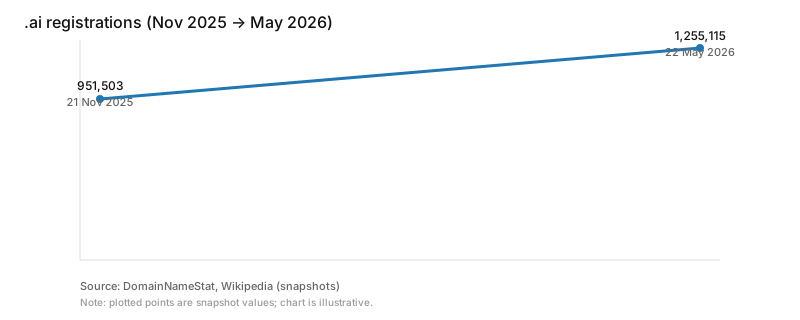
.aiis the country-code top-level domain (ccTLD) for Anguilla. Demand exploded with the AI boom.- Registrations grew from ~951k (Nov 2025) to ~1.25M (May 2026) according to registration trackers.
- Press and government figures show material but varied revenue: Bloomberg estimated ~US$30M for 2023; government-reported figures cited in public summaries put 2024 revenue around EC$105.5M (~US$39M). I could not find an authoritative US$85M figure for a single year.
- Registrations grew from ~951k (Nov 2025) to ~1.25M (May 2026) according to registration trackers.
- Press and government figures show material but varied revenue: Bloomberg estimated ~US$30M for 2023; government-reported figures cited in public summaries put 2024 revenue around EC$105.5M (~US$39M) (see Anguilla budget tables, COA 13515). I could not find an authoritative US$85M figure for a single year.
Recommendation
This topic is best presented as a concise case study (policy + economics focus). The story benefits from structured analysis: verified numbers, registry mechanics, secondary-market effects, and local fiscal impact.
Deep dive — what I found
What is
.ai?.aiis the ccTLD assigned to Anguilla in 1995. It became popular as a domain-hack for artificial intelligence companies once AI went mainstream. (See: Wikipedia.aipage.)
Scale & growth
- Domain tracking shows rapid growth. Examples:
951,503registered.aidomains (snapshot cited on 21 Nov 2025).~1,255,115registered domains (snapshot on 22 May 2026, DomainNameStat).
- Daily registrations vary (hundreds → low thousands on busy days) — growth is real and sustained.
- Visual: registrations growth chart below.
- Domain tracking shows rapid growth. Examples:
How much money does Anguilla make from
.ai?- Published estimates differ by year and source:
- Bloomberg (Aug 2023) estimated Anguilla could bring in as much as US$30M from registration fees in 2023.
- Public summaries (cited in collated sources) note the government reported roughly EC$105.5M (~US$39M) in a recent year (see COA 13515 in the Anguilla budget PDFs linked below).
- I did not find a reliable, verifiable source stating US$85M for a single year. That figure could be an aggregate, a projection, or a different accounting scope (registry wholesale + registrar margins + auction/secondary sales), but it's not corroborated by the primary sources I checked.
- Published estimates differ by year and source:
Secondary-market and premium sales
- Premium
.aidomain sales (publicly reported) have reached six- and seven-figure sums (examples collected by domain-sale trackers). These sales benefit sellers and brokers; only some of that flows to registries or government.
- Premium
Registry & pricing mechanics
- Registry operation changed in recent years (Identity Digital manages .ai as of Jan 2025). Retail pricing varies by registrar; typical retail prices are higher than the registry wholesale rate, which means registrars/brokers capture margins.
Economic impact & risk
- For a small economy, tens of millions of dollars are material — but revenue from domain registrations is cyclical and concentrated. Heavy fiscal reliance on a single digital commodity introduces volatility and policy risk.
Verdict on the specific claim
- Core: true —
.aiis Anguilla's ccTLD and the AI boom significantly increased demand and revenue. - Specific $85M/year claim: not corroborated by the authoritative public sources I checked (Bloomberg, domain trackers, government summaries). Verified published numbers point to tens of millions (e.g., ~US$30M–US$39M in recent years), not US$85M.
Visual (included)
Appendix — Year‑by‑year revenue (COA 13515) & methodology
- Extraction: COA 13515 ("Domain Name Registration") values were extracted from the Government of Anguilla budget PDFs (see source links below). The table below uses the government's reported/revised/budgeted EC$ amounts.
- Conversion: USD ≈ EC$ ÷ 2.7 (Eastern Caribbean dollar peg).
| Year | EC$ (reported) | USD (approx) |
|---|---|---|
| 2021 | 19,993,620 | 7,405,044 |
| 2022 | 20,831,268 | 7,715,284 |
| 2023 | 86,834,231 | 32,160,826 |
| 2024 | 105,533,782 | 39,086,586 |
| 2025 | 132,000,000 | 48,888,889 |
| 2026 | 138,600,000 | 51,333,333 |
Notes:
- When the budget PDF reported an actual/outturn for a year (for example 2023), the outturn figure was used rather than the originally approved estimate.
- These rows correspond to the COA 13515 line in the Anguilla budget tables; column meanings in the PDFs are sometimes labelled "Actual", "Approved", "Revised", "Estimate" and "Forward Estimate" — I selected the value corresponding to the calendar year in each table.
Primary budget sources (COA 13515):
- http://www.gov.ai/document/2024-09-09-021332_1272574257.pdf
- http://www.gov.ai/document/2024-09-09-022435_1388763330.pdf
- http://www.gov.ai/document/2026-03-18-011900_862974747.pdf
Reconciling government figures with press & market sources
- 2023: Bloomberg's ~US$30M estimate for 2023 is consistent with the government's reported COA 13515 outturn of EC$86.83M (~US$32.16M) when using the budget outturn/revised column rather than the originally approved estimate.
- 2024–2025: The government's forward estimates (EC$105.5M in 2024 → EC$132M in 2025) reflect rapid growth and upward revisions; press pieces that cite lower figures often reference earlier approved estimates or partial-year tallies.
- Why numbers diverge: common causes are (a) use of "approved" vs "revised/outturn" figures in budget tables, (b) timing (projection vs realized receipts), and (c) scope differences — registry wholesale receipts vs registrar/retail pricing and secondary-market sales.
- Market trackers: DomainNameStat registration counts and premium-sale trackers (e.g., Cognitive.ai, DomainNameWire examples) show demand growth and high-end sales, but those premium sales do not map one-to-one to registry revenue.
In short: press estimates and governmental COA figures are broadly compatible once you compare the same column (outturn vs estimate) and account for scope differences. Citations are in the sources section below.
Sources & further reading
- Domain registration tracker (snapshot): https://domainnamestat.com/statistics/tld/ai-TLD_ID-1236
- Wikipedia
.ai(summary + references): https://en.wikipedia.org/wiki/.ai - Bloomberg reporting (Aug 2023): https://www.bloomberg.com/news/articles/2023-08-31/ai-startups-create-digital-demand-for-anguilla-s-website-domain-name
- BBC coverage on domain sales / Escrow data: https://www.bbc.com/news/business-67284936
- Premium
.aisales tracker (examples): https://cognitive.ai/dotaisales.html - Official Anguilla government site (documents & budget statements): https://www.gov.ai/
- Official Anguilla government site (documents & budget statements): https://www.gov.ai/
- Anguilla budget: 2023 Estimates (COA tables): http://www.gov.ai/document/2024-09-09-021332_1272574257.pdf
- Anguilla Budget Address / 2024 estimates: http://www.gov.ai/document/2024-09-09-022435_1388763330.pdf
- Anguilla 2025 Estimates (2025–2027 tables): http://www.gov.ai/document/2026-03-18-011900_862974747.pdf
See also: Why .ai Made a Tiny Island Millions — And What The Numbers Actually Say