
Yesterday, Sarvam Epoch rewrote the conversation around India's AI roadmap.
Not because one more model was announced.
Not because one more keynote went viral.
And not only because Sarvam 105B is being positioned at $0.80 per million blended tokens, reportedly far cheaper than comparable global models.
The bigger story is this:
Sarvam is trying to move India from using AI models to owning the full AI stack.
That stack now stretches across foundation models, India-hosted inference, speech-to-text, text-to-speech, document intelligence, work agents, coding agents, on-device AI, smart glasses, enterprise deployment, and public-sector workflows.
That is why Epoch matters.
It was not a product event. It was a stack event.

For LensCraft IT Ventures, this is more than a news moment. It connects directly to the kind of India-first AI systems we have been researching: multilingual railway announcements, AI readiness audits, agentic workflows, public-service automation, and sovereign AI infrastructure for regulated sectors.
The question is no longer:
Can India build a model?
The question is:
Can India build the AI operating layer for Indian workflows?
Sarvam Epoch suggests the answer is becoming more serious.
What Sarvam Announced
Based on Sarvam's official Epoch page, Sarvam documentation, and credible coverage from Inc42, India Today, Economic Times, NDTV Profit, and Business Standard, the major announcements cluster into seven categories.
| Area | What Was Announced | Why It Matters |
|---|---|---|
| Foundation models | A plan to build a trillion-plus parameter model in India | Signals ambition beyond small/localized models |
| Inference | Sarvam Inference, an India-hosted model serving platform | Moves the conversation from model sovereignty to token sovereignty |
| Pricing | Sarvam 105B reported at $0.80 / 1M blended tokens | Makes high-volume Indian enterprise workloads economically plausible |
| Speech | Saaras V4 and Bulbul V4 upgrades | Critical for voice-first India, call centers, education, railways, healthcare |
| Vision/document AI | Sarvam Vision 2.0 and Vision Edge | Fits forms, tables, handwriting, land records, banking docs, government files |
| Agents | Work, Code, DocAgent, Samvaad and broader Indus agent stack | Turns models into workflow systems |
| Edge/devices | Sarvam Edge, Kaze smart glasses, local speech stack | Makes AI usable where cloud-only AI is too slow, costly, or risky |
This is why the event felt larger than a model launch.
It mapped an entire value chain.
Verified vs Still Needs Validation
For a serious technology analysis, we should avoid two traps:
- blind hype
- cynical dismissal
The right posture is excited but technically disciplined.
| Claim | Current Status | How We Should Interpret It |
|---|---|---|
| Epoch was held in Bengaluru on July 30-31, 2026 | Confirmed by Sarvam's Epoch page | Safe to state directly |
| Sarvam plans a trillion-plus parameter model built from scratch in India | Reported by multiple outlets | Treat as roadmap, not released product |
| New models expected within about six months | Reported by Inc42 | Use as company-reported timeline |
| Sarvam 105B at $0.80 per million blended tokens | Reported by Inc42, India Today, NDTV Profit | Powerful, but depends on blended token assumptions |
| Official Sarvam pricing lists 105B input/output rates in INR | Confirmed on Sarvam API pricing page | Use for grounded pricing context |
| Bulbul V4 adds more expressive/emotional speech control | Reported by Inc42 and India Today | Strong signal, but public docs still list Bulbul v3 as active |
| Saaras V4 improves multilingual, noisy and multi-speaker speech | Reported by Inc42 | Important for real-world voice workflows |
| Kaze smart glasses exist as a waitlist/product direction | Confirmed by Sarvam Kaze page | Safe to mention as device roadmap |
| Edge AI for Indian languages is part of Sarvam's product strategy | Confirmed by Sarvam Edge page | Important for offline/private/on-device use cases |
| Devendra Singh Chaplot joined as adviser and Sarvam is setting up a San Francisco office | Reported by Business Standard and Inc42 | Strategic global talent signal |
| "India's largest Blackwell GPU cluster" | Appears in social/event recaps; weaker public source trace | Mention only as a reported/claimed infra signal unless primary proof appears |
This table is important because the blog should not sound like a press release.
It should sound like a technical strategist asking:
What is real now?
What is roadmap?
What must be independently validated?
What can builders do with it?
The Price Story Is Big, But It Is Not The Main Story
The viral line is pricing.
Sarvam 105B is being described as costing $0.80 per million blended tokens, compared with reported global-model pricing of $4.50 and $9.00 per million blended tokens for competing mini/flash-class offerings.
If that economics holds at production quality, it matters deeply.
India-scale AI is not a demo-scale problem.
It means:
- millions of citizen-service calls
- daily railway and airport announcements
- high-volume BFSI customer support
- school and coaching workflows
- multilingual government grievance systems
- healthcare triage in regional languages
- small-business automation where margins are thin
In these markets, cost is not a footnote.
Cost decides whether AI becomes a boardroom toy or public infrastructure.
But price alone is not enough.
A cheap model without:
- reliable latency
- predictable quality
- Indian language accuracy
- enterprise governance
- data residency
- deployment flexibility
- strong developer experience
will not transform production systems.
That is why the real story is not:
Sarvam is cheaper.
The real story is:
Sarvam is trying to make India-hosted AI economically deployable at population scale.
That is a much more important claim.
Token Sovereignty: The Phrase That Matters
Inc42 reported Sarvam cofounder Vivek Raghavan framing the new inference platform around token sovereignty: serving a larger share of the AI tokens consumed in India through domestic infrastructure rather than overseas cloud providers.
That phrase deserves attention.
Most discussions of sovereign AI stop at model weights.
But sovereignty is broader than weights.
It includes:
- where inference happens
- where data flows
- who controls model updates
- how enterprises govern access
- where logs are stored
- whether workloads can run on-prem or in a VPC
- whether Indian languages are first-class, not afterthoughts
For regulated sectors, this distinction is critical.
BFSI, public-sector departments, healthcare, defense-adjacent systems, utilities, and railway infrastructure cannot treat AI as a random overseas API call forever.
They need AI that can live inside governance boundaries.
That is why Sarvam's stack strategy is stronger than a single-model story.
The Stack Map
Sarvam Epoch should be understood as a layered architecture.
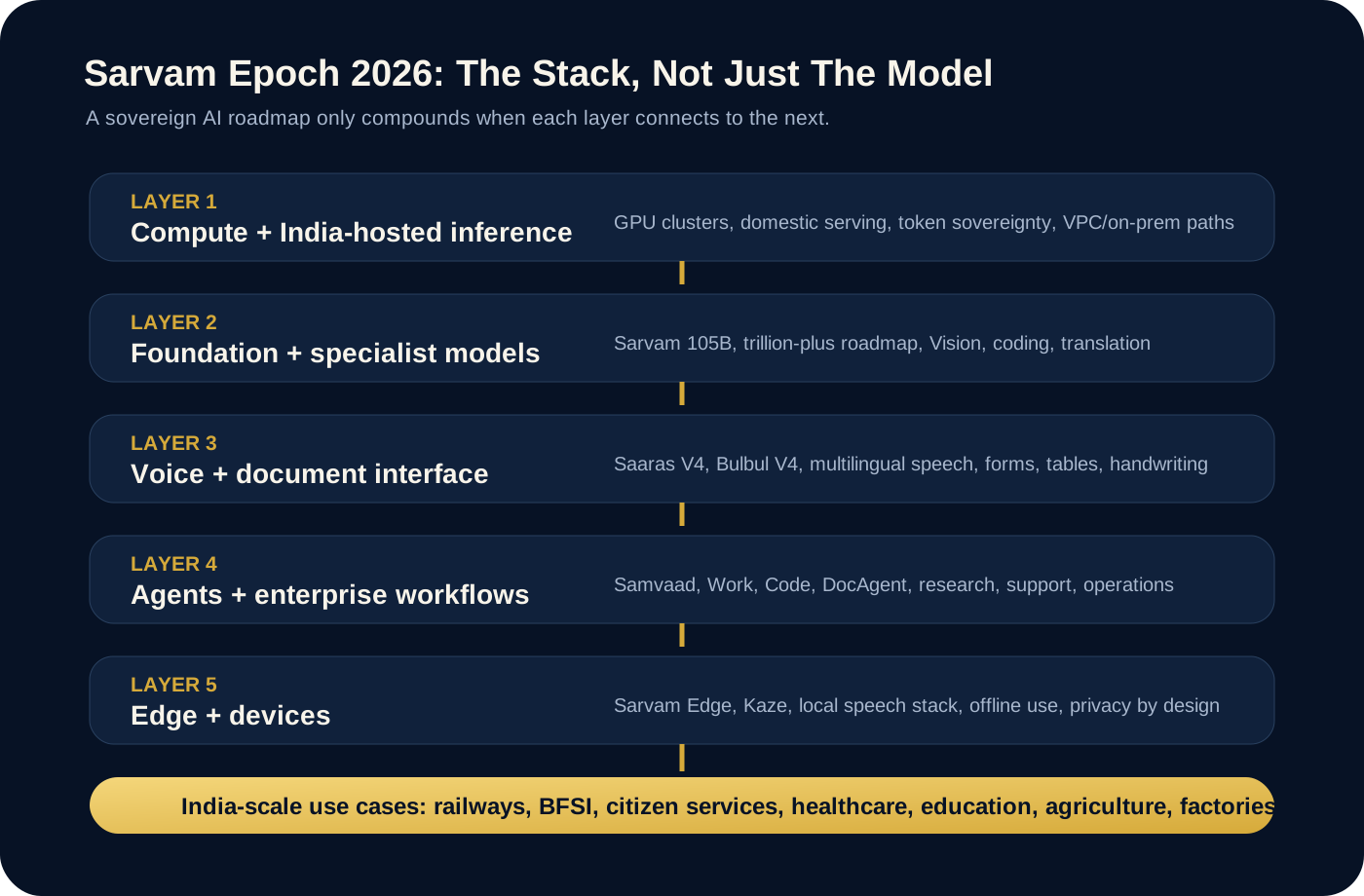
The most important insight is compounding.
Each layer reinforces the next:
- Cheap inference makes high-volume voice agents viable.
- Speech models make India-first interfaces viable.
- Document AI makes government and banking workflows viable.
- Edge AI makes offline and privacy-sensitive use cases viable.
- Agents convert raw model capability into repeatable business workflows.
- Devices push AI into the real world beyond phones and desktops.
This is how a local AI ecosystem becomes real.
Not by one benchmark.
By repeated deployment loops across sectors.
Why Bulbul V4 May Be The Most Underrated Announcement
The internet loves large parameter counts.
But for India, speech may matter more than size.
Bulbul V4 reportedly gives developers more control over expression, emotion, laughter, emphasis, and style shifts inside speech. That sounds like a novelty until you map it to real workflows.
Voice AI in India is not only about sounding pleasant.
It is about:
- trust
- clarity
- language comfort
- accessibility
- emotion-sensitive customer support
- lower training burden for non-technical users
- helping people interact without typing English prompts
Consider these examples:
- A railway announcement should sound calm during a platform change.
- A healthcare voice agent should sound reassuring without being casual.
- A loan collection call should be firm but not threatening.
- A government scheme assistant should sound patient and clear.
- An edtech tutor should be expressive enough to keep a learner engaged.
This is why emotional speech is not just a feature.
It is interface design.
If AI is going to serve India at scale, it cannot only read and write.
It has to speak.
And it has to speak with the right tone.
Why Edge AI Changes The Economics
Sarvam Edge is strategically important because it addresses three blockers at once:
- connectivity
- privacy
- marginal cost
Sarvam's Edge page describes a local stack for voice, transcription, and translation in 22+ Indian languages, with claims around fully local operation, no cloud dependency, and per-device deployment.
For high-frequency use cases, this changes the operating model.
Cloud AI pricing looks acceptable at low volume.
But in India, many real deployments are not low volume:
- a railway station running announcements all day
- a call center handling thousands of calls
- a school deploying voice tutoring for hundreds of students
- a factory floor using voice commands under noisy conditions
- a government counter handling walk-in citizen queries
At that point, local inference can become the difference between a pilot and a sustainable deployment.
This connects directly to our earlier railway research.
For Indian Railways, the strongest architecture is not cloud-only.
It is:
Cloud for dynamic generation
Edge cache for common and safety-critical messages
Local fallback for network degradation
Human control for emergency broadcasts
Audit logs for every announcement
Epoch makes that architecture feel less theoretical.
Agents: Where Models Become Workflows
The agent announcements matter because enterprises do not buy models.
They buy outcomes.
Inc42 reported Sarvam's broader Indus agent stack spanning offerings such as Samvaad, Work, Code, Content Agents, DocAgent, and Inference. The point is not that every named agent will dominate its category immediately.
The point is architectural:
Model capability -> agent orchestration -> workflow completion
That is how AI moves from demos to departments.
For Indian enterprises, this could mean:
- a banking agent that listens to a customer call, extracts intent, checks policy, and prepares a compliant response
- a government agent that reads scanned forms, extracts fields, and routes requests
- a railway agent that generates multilingual announcements from schedule changes
- a coding agent that works inside Indian enterprise repos with local governance
- a document agent that handles land records, loan files, invoices, and court documents
Again, the key differentiator is not simply that Sarvam has agents.
The differentiator is whether those agents are built on Indian language, speech, document, and deployment primitives from the same ecosystem.
That is what full-stack means.
Kaze And The Device Layer
Kaze, Sarvam's smart-glasses direction, matters even if the first version is early.
Why?
Because the future of AI is not only chat windows.
It is ambient.
It will live in:
- glasses
- cars
- phones
- kiosks
- factory devices
- railway counters
- classroom devices
- healthcare terminals
Sarvam's Kaze waitlist page frames the product as "a new way to see, hear, and understand." Combined with Sarvam Edge, this points toward AI that can operate closer to the human environment rather than only inside a cloud dashboard.
That is important for India because the next billion users may not start with typed prompts.
They may start with:
- voice
- camera
- document scan
- phone call
- local-language instruction
- assisted workflows
The AI interface for India will be multimodal by default.
The IBM Partnership Makes The Enterprise Story Stronger
Economic Times reported on July 31, 2026 that IBM and Sarvam partnered to build and test sovereign AI solutions for Indian government, public-sector organizations, and regulated enterprises.
That matters because one of the hardest parts of AI adoption is not model quality.
It is operational trust.
Enterprises ask:
- Where does data go?
- Who governs the model?
- Can this run inside our trusted environment?
- Can it satisfy compliance teams?
- Can it integrate with existing systems?
- Can we audit what the AI did?
According to ET, IBM Sovereign Core provides software and middleware for deployment and governance, while Sarvam adds reasoning models and multilingual voice/language technologies.
This partnership strengthens the full-stack narrative because it bridges:
AI capability + enterprise governance + regulated deployment
That is exactly where sovereign AI becomes commercially meaningful.
The India Use Cases That Become More Plausible
The strongest Sarvam Epoch story is not "India can compete with ChatGPT."
That framing is too narrow.
The stronger story is:
India can build AI systems for Indian operating conditions.
Here are the use cases where this matters most.
1. Railways And Public Announcements
Our earlier LensCraft case study explored Sarvam Saaras and Bulbul for Indian Railways multilingual announcements.
Epoch strengthens that thesis.
A next-generation railway PA stack could use:
- Saaras for transcribing operator speech
- Bulbul for multilingual announcements
- Sarvam Translate for 22-language coverage
- Edge for station-level caching and offline fallback
- Vision for document/operator logs
- agents for schedule-to-announcement workflows
- audit logs for safety-critical broadcasts
This is not about replacing station staff.
It is about giving staff faster, clearer, multilingual tools under pressure.
2. BFSI Voice And Document Workflows
Banks and NBFCs need local-language voice at scale.
They also process massive volumes of forms, statements, KYC documents, loan files, and support calls.
Sarvam's voice, document, and agent stack can be relevant if it proves:
- accuracy on real accents
- low-latency voice response
- compliance-safe deployment
- auditability
- strong extraction from Indian documents
3. Citizen Services
India's public services are multilingual, high-volume, and document-heavy.
An AI stack built for phone calls, local languages, forms, and government workflows can reduce friction across:
- grievance redressal
- welfare scheme navigation
- land records
- municipal services
- public health guidance
- agricultural assistance
4. Education
Voice-first AI tutors can matter deeply in regions where English typing is the wrong interface.
The more the stack supports local languages, speech, and offline deployment, the more realistic this becomes for schools, coaching centers, and rural learning programs.
5. MSME Productivity
Small businesses do not want to manage ten dashboards and prompt-engineer every workflow.
They need:
- voice dictation
- invoice reading
- WhatsApp-style customer support
- local-language sales assistance
- simple automation for documents and follow-ups
This is where Kivi, Work Agents, Samvaad, and document AI could converge.
What Sarvam Still Has To Prove
This is the part hype posts usually skip.
Sarvam's ambition is exciting, but the market will judge execution.
The key open questions:
| Question | Why It Matters |
|---|---|
| Will the trillion-plus model be independently benchmarked? | Parameter count alone does not prove capability |
| How does 105B perform on agentic, coding, reasoning, and Indian-language tasks? | Enterprises need workload-specific evidence |
| What is the real blended-token mix behind $0.80? | Pricing comparisons depend on input/output assumptions |
| When will Bulbul V4 and Saaras V4 be broadly available in public APIs? | Builders need availability, not only demos |
| Can edge models match cloud accuracy across noisy Indian conditions? | Edge is only powerful if quality holds |
| How strong are governance, audit, and safety controls? | Regulated deployment depends on trust |
| Can developer experience scale beyond early adopters? | Documentation, SDKs, examples, and support decide adoption |
| Can Sarvam balance India-first focus with global competition? | The SF office and global talent strategy will be tested |
This is why we should not call Epoch the finish line.
It is a starting gun.
What Builders Should Do Now
If you are a founder, CTO, or product leader in India, the practical takeaway is not "wait for the trillion model."
The practical takeaway is:
Start designing AI systems around Indian workflows now.
That means:
- choose use cases where language, speech, documents, or data residency matter
- prototype with Sarvam 105B, Saaras, Bulbul, Vision, and Translate
- define whether cloud, VPC, on-prem, or edge is required
- measure latency and cost per completed workflow, not only per token
- create human approval gates for high-risk actions
- build audit logs from the beginning
- test with real Indian accents, noisy audio, mixed scripts, and messy documents
- compare model quality on your own data, not only public benchmarks
The winning AI products in India will not be generic wrappers.
They will be workflow systems tuned to the way India actually works.
LensCraft POV: India's AI Advantage Is Not Copying Silicon Valley
India does not need to clone ChatGPT.
India needs AI systems that understand:
- 22 official languages
- code-mixing
- low-bandwidth environments
- phone-first access
- document-heavy workflows
- public-sector scale
- regulated enterprise constraints
- rural and semi-urban usage patterns
- speech-first interaction
That is the real opportunity.
Silicon Valley's default AI interface is often:
English prompt -> cloud model -> text answer
India's real AI interface may be:
voice + document + local language + workflow + edge + audit + human approval
That is not a smaller market.
It is a different design center.
And if Sarvam executes, Epoch may be remembered as the moment India started articulating that design center clearly.
Conclusion: The Stack Is The Strategy
Sarvam Epoch 2026 deserves attention because it points to a more mature AI roadmap for India.
Not only:
Build a large model.
But:
Build the models.
Serve the tokens locally.
Make speech natural.
Understand documents.
Run agents.
Deploy at the edge.
Integrate with enterprise governance.
Reach real India-scale workflows.
That is the game-changing part.
The next six months will determine how much of this becomes production reality.
But the direction is clear:
India's AI race is moving from model sovereignty to system sovereignty.
And system sovereignty is where the real impact begins.
Sources & Further Reading
- Sarvam AI, "Sarvam Epoch: AI, In Your Hands", official Epoch event page.
- Sarvam AI, "Models", official API documentation.
- Sarvam AI, "API Pricing", official pricing page.
- Sarvam AI, "Sarvam Edge", official edge AI product page.
- Sarvam AI, "Kaze Waitlist", official Kaze product page.
- Inc42, "Sarvam To Build Trillion-Parameter AI Model, Launches India-Hosted Inference Service", July 30, 2026.
- India Today, "Sarvam announces 1 trillion parameter AI model, vision and speech getting new updates", July 30, 2026.
- Economic Times, "Everything Sarvam AI announced at its Epoch Builder Edition", July 2026.
- NDTV Profit, "Sarvam AI Building One Trillion Plus Parameter Model", July 2026.
- Business Standard, "Sarvam ropes in Mistral founding team member Devendra Chaplot as adviser", July 30, 2026.
- Economic Times, "IBM, Sarvam partner to build sovereign AI solutions for Indian government, regulated sectors", July 31, 2026.
- LensCraft IT Ventures, "Sarvam Saaras v3 for Indian Railways: Multilingual Announcements & Schedule Updates".