
A quiet but seismic shift is occurring behind the closed doors of the world's leading artificial intelligence laboratories.
In the first week of June 2026, both Anthropic and OpenAI took formal steps toward public markets, submitting confidential draft registration statements (Form S-1) to the U.S. Securities and Exchange Commission (SEC). Behind this regulatory rush lies a massive financial reality: a combined private-market valuation nearing $1.8 trillion, and a desperate race to prove sustainable, recurring enterprise monetization.
Almost simultaneously, a report from the Financial Times, citing more than a dozen current and former employees, leaked a striking internal declaration from a senior OpenAI staffer: "Chat is dead."
In its place, OpenAI is preparing a radical, top-to-bottom redesign of ChatGPT. Within weeks, the iconic, message-bubble interface that defined the early era of generative AI is expected to transform into a unified "AI superapp." This superapp will no longer simply respond to prompts; it will act as an orchestration layer for autonomous agents, coding systems, and partner services.
At LensCraft IT Ventures, we analyze technology at the intersection of product architecture and market strategy. OpenAI’s shift away from the chat interface is not a mere UI redesign; it is a fundamental pivot in how software is constructed, monetized, and deployed.

The $1.8 Trillion IPO Context: A Structural Comparison
To understand why OpenAI is discarding the interface that brought it 1 billion users, one must follow the capital.
The public market debut of these AI giants will represent one of the most anticipated financial events in tech history. However, the private valuations that underwrite this moment are under immense pressure to show high-margin, enterprise-scale revenue streams rather than free consumer usage.
| Dimension | Anthropic | OpenAI |
|---|---|---|
| S-1 Confidential Filing Date | June 1, 2026 | June 8, 2026 |
| Latest Private Valuation | ~$965 Billion (Series H) | ~$852 Billion (March 2026) |
| Listing Valuation Target | Up to $1.1 Trillion | Up to $1.0 Trillion |
| Core GTM Strategy | Enterprise-first, API-centric, strict safety alignment | Consumer-first (historical), shifting to Enterprise Superapp (current) |
| Key Revenue Engine | Custom enterprise agents, Claude for Work | ChatGPT Plus, API tokens, Codex, Enterprise Hubs |
Anthropic’s recent surge in valuation to $965 billion—leapfrogging OpenAI’s last private round—was driven almost entirely by its success in marketing to enterprise clients rather than the general population. By positioning Claude as a secure, structured, API-first "system of intellect" for corporate workflows, Anthropic demonstrated a clearer path to per-token and seat-based profitability.
For OpenAI, ChatGPT’s massive consumer footprint has become a double-edged sword. While it commands dominant mindshare, running inference for hundreds of millions of free users incurs staggering computational costs. To secure a listing valuation at or above $1 trillion, OpenAI must rapidly convert this consumer attention into high-margin enterprise adoption. The tool to achieve this is the superapp.
Why Chat Is Dead: The Three Eras of AI Interfaces
To evaluate why the chat box has run its course, we must examine the evolution of how humans interact with compute power.
We are transitioning between three distinct eras of user interface design:
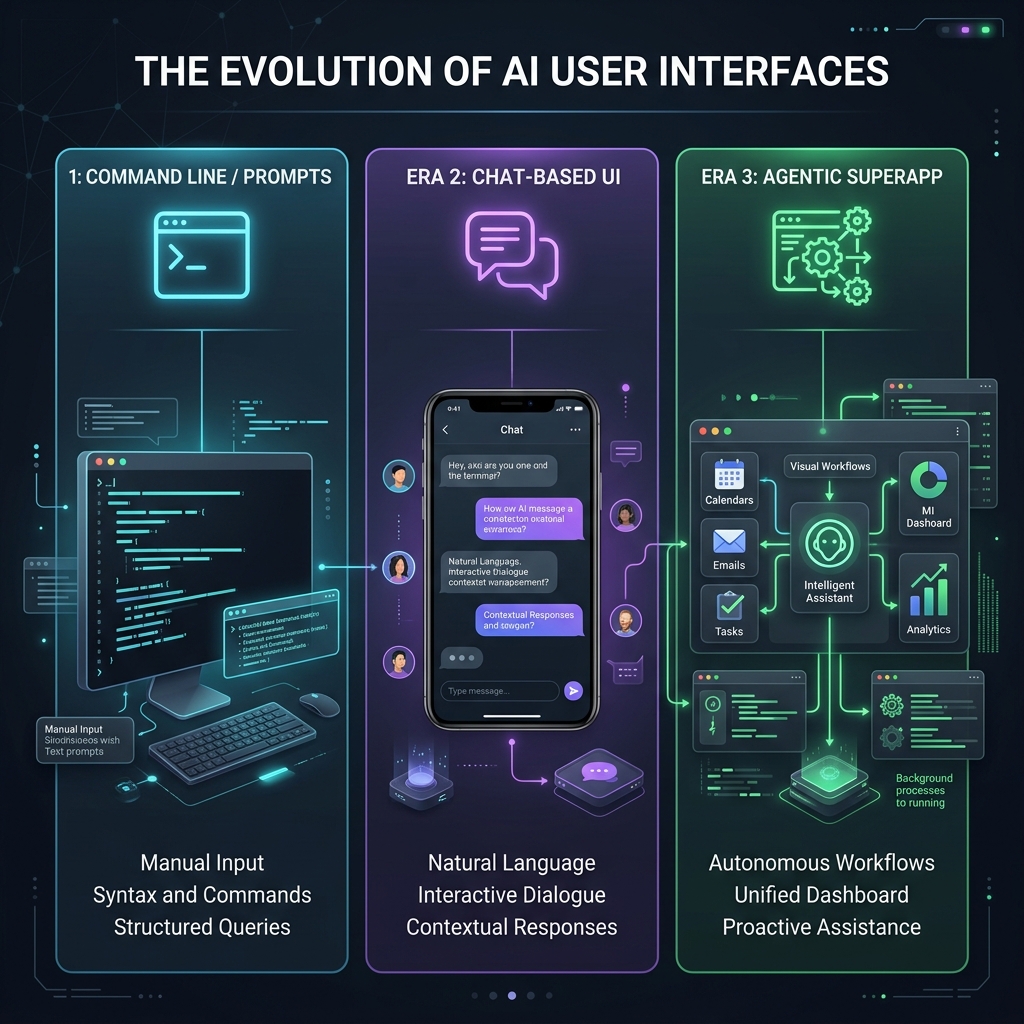
Era 1: Command Line / Prompts (2020–2022)
In the early days of large language models (LLMs) like GPT-3, interaction was highly technical. Users wrote long, brittle "system prompts," engineered specific formatting templates, and managed raw API outputs. The user had to speak the machine's language.
Era 2: Chat-Based UI (2022–2025)
ChatGPT popularized the conversational paradigm. The chat bubble made AI accessible to the masses. However, as a productivity tool, chat is highly inefficient:
- The Prompting Tax: It requires humans to constantly type, refine, and copy-paste text to get a result.
- The Bandwidth Bottleneck: Text generation is linear and slow. Getting a complex task done requires a continuous, multi-turn back-and-forth dialogue.
- Lack of Persistence: Traditional chat threads are ephemeral. They do not maintain active state or run background tasks after the browser tab is closed.
Era 3: The Agentic Superapp (2026+)
The future of AI interaction is intent-based execution. Instead of prompting an AI to write an email, draft a contract, and upload it to a drive—a process requiring three separate chat turns—the user specifies an objective. The system automatically coordinates multiple sub-agents to execute these tasks in parallel, fully in the background.
The Anatomy of the OpenAI Superapp
The impending ChatGPT redesign represents a physical consolidation of OpenAI’s fragmented product offerings into a singular workspace. This layout is heavily inspired by the product vision outlined by Chief Revenue Officer Denise Dresser in April 2026, describing a "unified AI superapp as the primary experience where employees get things done."
The redesigned architecture focuses on three core pillars:
1. Codex as a Native Engine
Rather than treating code generation as a chat response, coding tools are being integrated directly into the workspace layout. Users will interact with side-by-side IDE environments where the AI acts as a co-programmer, editing, compiling, and running code locally on the fly.
2. "Agentic Browsing" and Workflows
The superapp will incorporate persistent background agents. If a user asks the app to "monitor competitor pricing and update our spreadsheet every Monday," the agent runs autonomously at the API level, utilizing sandboxed browsers to scrape, parse, and structure data without requiring the user to keep ChatGPT open.
3. Deep Integration of Third-Party "Apps"
OpenAI is moving past the failed "Plugins" model of 2023. The new interface will encourage users to seamlessly invoke partner applications—such as Canva, Booking.com, or corporate SQL databases—directly within the workspace. The AI will handle the data transformations between these services, translating a text-based instruction into structured API payloads for external apps.
Ultimately, OpenAI’s goal is to remove the "send" button. As FT reported:
"OpenAI intends to ditch the prompts and features, betting that its models will be able to automatically understand users’ intentions when they are on the app or site."
The Strategic Playbook for Startups and Enterprises
As the two leading AI platforms shift from chat boxes to agentic superapps, the downstream implications for software builders are profound. The "chat widget" is no longer the target interface.
1. Build for Agentic Consumability (APIs over UIs)
If ChatGPT and Claude become superapps that execute tasks on behalf of users, they will interact with your business not through your web dashboard, but through your APIs. Startups must ensure their systems are designed for autonomous machine navigation. This means structured schema definitions, predictable error handling, and robust auth patterns tailored for AI agents.
2. Prepare for the "Promptless" Interface
The transition to intent-based UI means your application should anticipate needs rather than waiting for explicit commands. Designing software in 2026 requires building state machines that can interpret user context, past actions, and external triggers to recommend and execute multi-step workflows.
3. The Token Economy replaces the Seat License
For enterprise buyers, the standard SaaS seat license ($20/user/month) is losing utility. If an AI agent can do the work of ten virtual assistants, companies will demand pricing models based on utility and task execution (tokens consumed, workflows completed) rather than human heads. Enterprise software companies must adapt their billing models to align with agentic productivity.
Conclusion: The Horizon Beyond the Chat Box
The declaration that "chat is dead" is not a sign that generative AI is slowing down; it is a sign of its maturity.
Chat was the training wheels of artificial intelligence. It was a comfortable, familiar metaphor (texting) that allowed humanity to get used to talking to machines. But as OpenAI and Anthropic prepare to cross the threshold into public markets, they must shed the limitations of the chat box and build the new operating system for digital work.
The transition to the agentic superapp represents the next major interface revolution. The companies that succeed will not be those that build the cleverest chatbots, but those that design the most invisible, autonomous, and integrated systems of execution.
Sources & Further Reading:
- Mike Pearl, "'Chat Is Dead': OpenAI Reportedly Planning Radical Changes to ChatGPT," Gizmodo (June 7, 2026).
- Financial Times, "OpenAI plans radical ChatGPT overhaul to create 'superapp' and drive revenue," (June 2026).
- Denise Dresser, "The Next Phase of Enterprise AI," OpenAI Blog (April 2026).
- SEC Filings, Form S-1 Confidential Draft Registration Statements: Anthropic (June 1, 2026); OpenAI (June 8, 2026).