
India is staring down a water crisis that most urban Indians never see.
Beneath the vast, sun-scorched fields of North Gujarat—particularly in districts like Mehsana, Banaskantha, and Patan—groundwater tables are falling at an alarming rate. Agriculture consumes 87–90% of India's total freshwater extraction, and much of it is wasted through flood irrigation: a centuries-old practice of simply flooding entire fields, regardless of where moisture is actually needed.
The result is a silent, slow-motion catastrophe. Borewells that once reached water at 100 feet must now be sunk 600 feet or more. Farmers—already under immense financial pressure—face ballooning electricity and diesel pump bills just to water the same crops their grandfathers watered for a fraction of the cost.
Into this crisis walked Ayan Patel, a 16-year-old student from Mehsana, with a rover, a dream, and a family legacy that demanded he act.
The Inheritance of a Problem
Before we talk about technology, we must talk about history—because Ayan's story cannot be understood without it.
His great-grandfather, Shaheed Vir Tribhuvandas Patel, was not just a farmer. He was a farmer-rights activist and a pioneer who dug the region's first borewell, a revolutionary act at a time when groundwater irrigation was a radical concept. He fought for the dignity and economic independence of the small farmer in an era when the rural poor were almost entirely at the mercy of seasonal rains and landlords.
Ayan grew up knowing this legacy. He grew up watching farmers—his community—still struggling, just in different ways. Instead of fighting for access to water, they were now fighting to afford it, to manage it, and to stop wasting it.
When he looked at precision agriculture technology, he saw the same gap that existed in his great-grandfather's era: powerful solutions existed in theory, but were completely inaccessible to the farmers who needed them most. Commercial precision irrigation systems cost lakhs of rupees. They require stable WiFi or cellular connectivity. They require specialized maintenance. And they're sold by companies that don't understand the reality of a 2-acre smallholder plot in semi-arid North Gujarat.
Ayan decided to build something different.
What is SaurSinchAI? A Technical Breakdown
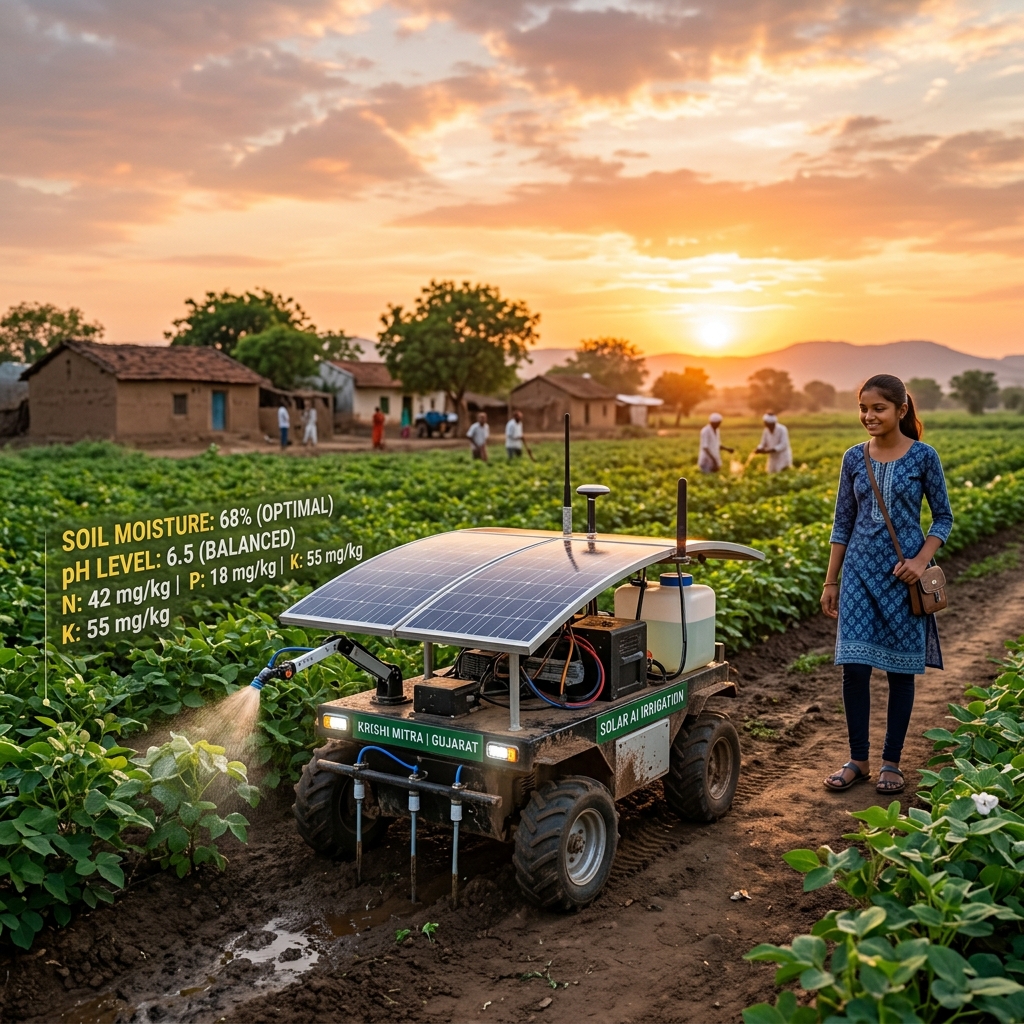
SaurSinchAI (Saur = Solar, Sinch = Irrigation, AI = Artificial Intelligence) is a compact, autonomous, solar-powered rover designed specifically for the conditions of smallholder farms in rural India. It is not a drone. It is not a cloud-connected platform. It is a ground-based, self-propelled precision irrigation and soil-monitoring machine.
Here's what makes it technically significant:
1. Mobile Soil Sensing — Real-Time, In-Field
Instead of relying on fixed soil sensors installed at static points in a field (a common limitation of cheaper smart irrigation systems), SaurSinchAI carries mobile soil probes that move through the field as the rover does. These probes continuously measure:
- Soil moisture levels at the root zone
- Soil pH (critical for determining nutrient availability and soil health)
- NPK levels — Nitrogen (N), Phosphorus (P), and Potassium (K), the three primary macronutrients for crop growth
This mobile approach is critical. Soil conditions are highly heterogeneous — the moisture level at one end of a 2-acre field can be dramatically different from the other end. A single fixed sensor gives you one data point. A rover traversing the field gives you a continuous soil health map.
2. Precision Delivery — Water, Fertilizer, Pesticides, Only Where Needed
Based on the real-time soil data, SaurSinchAI's AI model determines exactly how much water, fertilizer, or pesticide needs to be applied at each specific GPS-tagged location in the field. It then activates micro-nozzles to deliver only the precise quantity needed at that precise location.
This is the fundamental shift from conventional irrigation to precision agriculture: instead of applying a uniform dose to an entire field (which inevitably means some areas get too much and others get too little), the system delivers the exact right input to every square metre.
3. No WiFi, No Fixed Infrastructure Required
This is perhaps SaurSinchAI's most important design constraint — and most important achievement. The system is built to function fully offline, without requiring any WiFi or cellular data connectivity. The AI runs locally on the rover's onboard processor.
In rural North Gujarat, internet connectivity can be unreliable or nonexistent in the middle of a field. Building a system that depends on the cloud would mean building a system that fails precisely when and where farmers need it. Ayan built around this constraint from day one.
4. 100% Solar-Powered
The rover is powered entirely by integrated solar panels. This eliminates the need for grid electricity or diesel — both of which are expensive, unreliable, or environmentally costly in rural settings. The system can operate continuously during daylight hours and stores energy for short operational periods at dawn or dusk.
The Numbers: What the Pilot Trials Showed
Pilot trials of SaurSinchAI on farms in North Gujarat have produced verifiable, significant results:
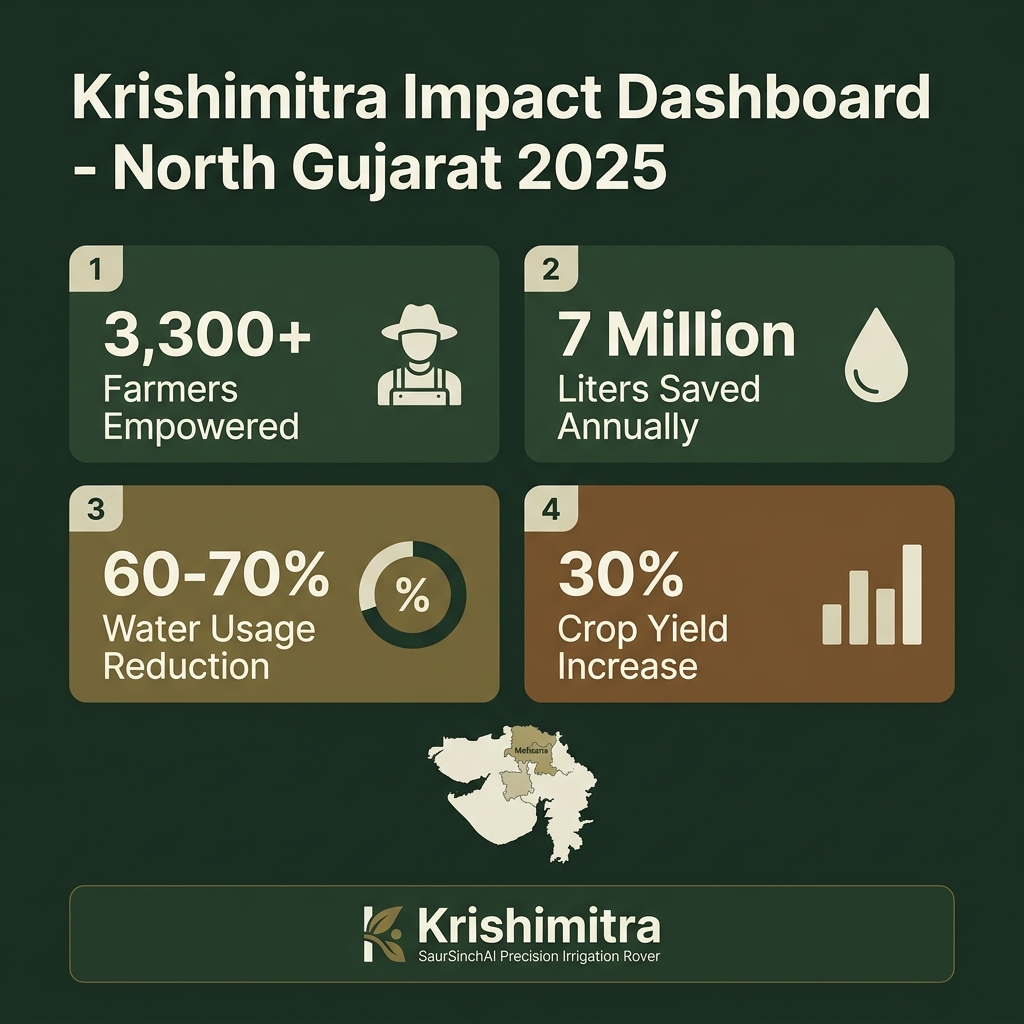
| Metric | Baseline (Flood Irrigation) | SaurSinchAI Result | Improvement |
|---|---|---|---|
| Water consumption | 100% | ~30–40% | 60–70% reduction |
| Pesticide costs | 100% | ~65% | 35% reduction |
| Crop yields | Baseline | Baseline + 30% | 30% increase |
| Annual water saved (Krishimitra network) | — | 7 million litres | — |
A 60–70% reduction in water consumption is not incremental improvement. In a region where groundwater depletion is measured in meters per year, this is transformative. It is the difference between a borewell that lasts another decade and one that runs dry next season.
The Bigger Project: Krishimitra is More Than a Rover
SaurSinchAI is the technological centrepiece of Ayan's work, but it sits inside a much broader initiative he calls Krishimitra (literally "Farmer's Friend" in Sanskrit and Gujarati).
Krishimitra is a grassroots, community-first model that recognizes a critical truth that most agritech startups ignore: technology alone does not transform agriculture. A rover that farmers don't understand, don't trust, or can't maintain is just an expensive piece of machinery sitting in a shed.
Krishimitra addresses this through three integrated pillars:
Pillar 1: Farmer Education & Training
Ayan partnered with Krishi Vigyan Kendras (KVKs)—India's network of government agricultural extension centres—and Ganpat University to build structured training programs for farmers. These programs cover:
- Soil health literacy: Understanding what soil pH, NPK, and moisture data actually means for crop decisions
- Digital skills: Basic operation of the rover, reading data outputs, understanding alerts
- Organic and sustainable farming: Moving away from chemical-heavy practices towards techniques supported by real-time soil data
To date, Krishimitra has directly reached over 3,300 farmers in North Gujarat.
Pillar 2: Women's Economic Empowerment — Gruh Udyog
Ayan identified women as a critical but underutilized force in rural agricultural ecosystems. Through the Gruh Udyog (home-based industry) initiative, Krishimitra has enabled hundreds of rural women to become micro-entrepreneurs by teaching them to:
- Process and sell locally grown agricultural products (organic produce, value-added food products)
- Manage supply chains for small-scale farm produce
- Access digital payment and banking tools
This is a sophisticated recognition that the economics of farming cannot be improved by irrigation efficiency alone. If women in farming households can generate additional income streams, the entire household's resilience improves.
Pillar 3: Youth Mobilization — Vigyan Viplav Labs
Ayan also recognized that the next generation of farmers needs to grow up believing that technology and agriculture are compatible — that being a farmer doesn't mean abandoning science. Through Vigyan Viplav Labs (Science Revolution Labs), Krishimitra runs hands-on STEM education programs in rural schools across Gujarat, inspiring young people to see innovation as something that happens in their own backyards, not just in Bengaluru.
Why This Story Is a Systemic Signal, Not Just an Inspiring Tale
It would be easy to file this story away under "heartwarming innovation news" and move on. That would be a mistake. Ayan Patel's work is a systemic signal that should be analysed carefully.
Signal 1: The Infrastructure-Free Design Imperative
The dominant agritech innovation ecosystem — centred in cities, funded by urban venture capital, built by engineers who've never farmed — consistently produces solutions that require stable internet, smartphones, cloud subscriptions, and technical support teams. These solutions work beautifully in demonstration fields and fail in rural reality.
Ayan's design philosophy — offline-first, hardware-autonomous, solar-powered — is the correct design philosophy for rural India. It should be a mandatory design constraint for every agritech product targeting farmers below the Decile 8 income level.
Signal 2: Community Before Technology
Technology adoption in Indian agriculture is estimated at below 5% among smallholder farmers despite two decades of investment. The primary reason is not cost (though cost is a significant factor). The primary reason is trust and literacy. Farmers adopt technology when they understand it, when their neighbours understand it, and when there's a local person they can call when something goes wrong.
Krishimitra's KVK partnerships and farmer training programs represent a fundamentally more mature go-to-market model than most agritech startups deploy. Ayan built the community infrastructure alongside the technical infrastructure — which is why the rover is actually being used.
Signal 3: The Groundwater Clock Is Ticking
The Central Ground Water Board's data is unambiguous: India is over-extracting groundwater at a rate that threatens the long-term viability of its agricultural sector. In states like Gujarat, Punjab, and Haryana, the situation is critical.
Precision irrigation is not a "nice to have" feature for yield optimization. It is an existential necessity for aquifer survival. A 60–70% reduction in water use, if scaled, is not just good for individual farmers' economics — it is the difference between a viable agricultural region and a desertified one a generation from now.
Signal 4: A 16-Year-Old Built What Billion-Dollar Companies Haven't
There are numerous well-funded Indian agritech startups working on smart irrigation. Most of them are selling SaaS subscriptions to large commercial farms. Ayan built a hardware-software-community solution for smallholder farmers, without WiFi dependency, and at a cost that's actually relevant to someone farming 2 acres.
The lesson is not that startups are incompetent. The lesson is that proximity to the problem produces better solutions. Ayan grew up in the community he is trying to serve. He understood, at a gut level, what the constraints were. This is why his solution works where others don't.
Recognition: The World Is Paying Attention
Ayan's work has not gone unnoticed. He has been awarded the Gold Crest Award by the United Kingdom for his contributions to innovation and real-world STEM problem-solving — one of the most prestigious international recognitions for young innovators.
His story has been covered by Krishi Jagran, Adani Foundation platforms, and regional media across Gujarat. But perhaps more significantly, the KVK network — India's ground-level agricultural extension infrastructure — has validated his approach by partnering with Krishimitra directly.
The LensCraft Lens: What We're Watching
At LensCraft IT Ventures, we study technology precisely at these intersections: where deep tech meets real-world infrastructure constraints, where social complexity shapes technical design, and where young, embedded innovators outperform institutional R&D.
Ayan Patel's work exemplifies several trends we're tracking closely:
- Edge AI for resource-constrained environments: Running AI inference locally, without cloud dependency, is the correct technical path for rural India. The hardware costs continue to fall.
- Frugal innovation as competitive advantage: The constraints Ayan built around — no WiFi, no grid electricity, no technical support staff — are features, not bugs. They're what makes SaurSinchAI deployable.
- Community-anchored technology rollout: The Krishimitra model — technology + education + women's empowerment + youth engagement — is a template that serious agritech companies should study.
- India's groundwater emergency as a forcing function for precision agriculture: Policy tailwinds from Atal Bhujal Yojana, PM-KUSUM solar pump schemes, and NITI Aayog's Jal Shakti initiatives will increasingly favour precision irrigation solutions. The regulatory and funding environment is aligning.
India cannot solve its agricultural water crisis with the same thinking that created it. The solution will come from people who understand both the technology and the land — people like Ayan Patel.
At 16, he has built something most adults haven't: a solution that actually works, for the people who actually need it, in the conditions they actually live in.
That is the highest standard of engineering
Source: Krishi Jagran, Krishimitra.org, Adani Foundation, Central Ground Water Board (CGWB) Reports, NITI Aayog — Jal Shakti Mission Data.