
There is a phrase that has become a quiet consensus among researchers, advocates, and legal scholars who work at the intersection of artificial intelligence and human dignity: "Deepfake abuse is abuse."
It is not a content moderation problem. It is not a terms-of-service dispute. It is not a privacy inconvenience. It is a systematic, technologically-enabled form of sexual violence — one that scales at machine speed, operates across borders, and leaves victims with almost no effective recourse.
In this analysis, we examine the architecture of this crisis: the industry dynamics driving it, the technology enabling it, the documented harm it inflicts, the global legal responses attempting to contain it, and what a realistic path forward looks like for policymakers, platforms, and the people it targets.
This is not a comfortable read. That is precisely the point.
Part 1: The Industry — A $97 Billion Market With No Gatekeepers
To understand the deepfake pornography crisis, you must first understand the industry it has colonized.
The global adult entertainment market is estimated to be worth approximately $95–97 billion in 2025, approaching $100 billion in 2026. It is one of the largest, fastest-growing, and most profitable digital content sectors in the world — and it has almost no equivalent of the regulatory infrastructure that governs other comparably sized industries (financial services, healthcare, food production).
AI has not disrupted this industry. It has detonated it.
The Three Business Models Powering AI Adult Content
Model 1: AI Girlfriend / Companion Platforms These platforms (dozens now operate globally) allow users to generate, interact with, and sexually customize AI-generated personas. Business model: monthly subscriptions ($10–$20) with high-ticket upsells — custom photo/video credits, AI voice cloning for personalized audio, and long-form roleplay interactions that are designed to maximize emotional attachment and therefore ARPU (average revenue per user).
The content generated on these platforms is, technically, synthetic. No real person was involved. This is where the industry draws a legal comfort zone. But the technology developed and normalized here does not stay in the comfort zone.
Model 2: Creator "Productivity" Tools Multiple platforms now market themselves as "tools for adult content creators" — allowing performers to create AI-generated "digital twins" of themselves for automated content production. The ostensible use case is reducing performer burnout. The actual effect is creating a standardized pipeline for digitally cloning real faces, bodies, and voices — normalizing the technical workflow that enables non-consensual use.
Model 3: Open-Source Model Proliferation This is the most dangerous vector, and it has no business model to regulate. When open-source image and video generation models (including fine-tuned variants of mainstream diffusion models) are made freely available, they are immediately downloaded, modified, and deployed for the generation of non-consensual intimate imagery (NCII). There is no subscription to cancel. There is no payment processor to pressure. There is no company to sue.
Part 2: The Numbers — What "Scale" Actually Means
The statistics on deepfake pornography are not just alarming. They represent a structured, empirically verified catastrophe.
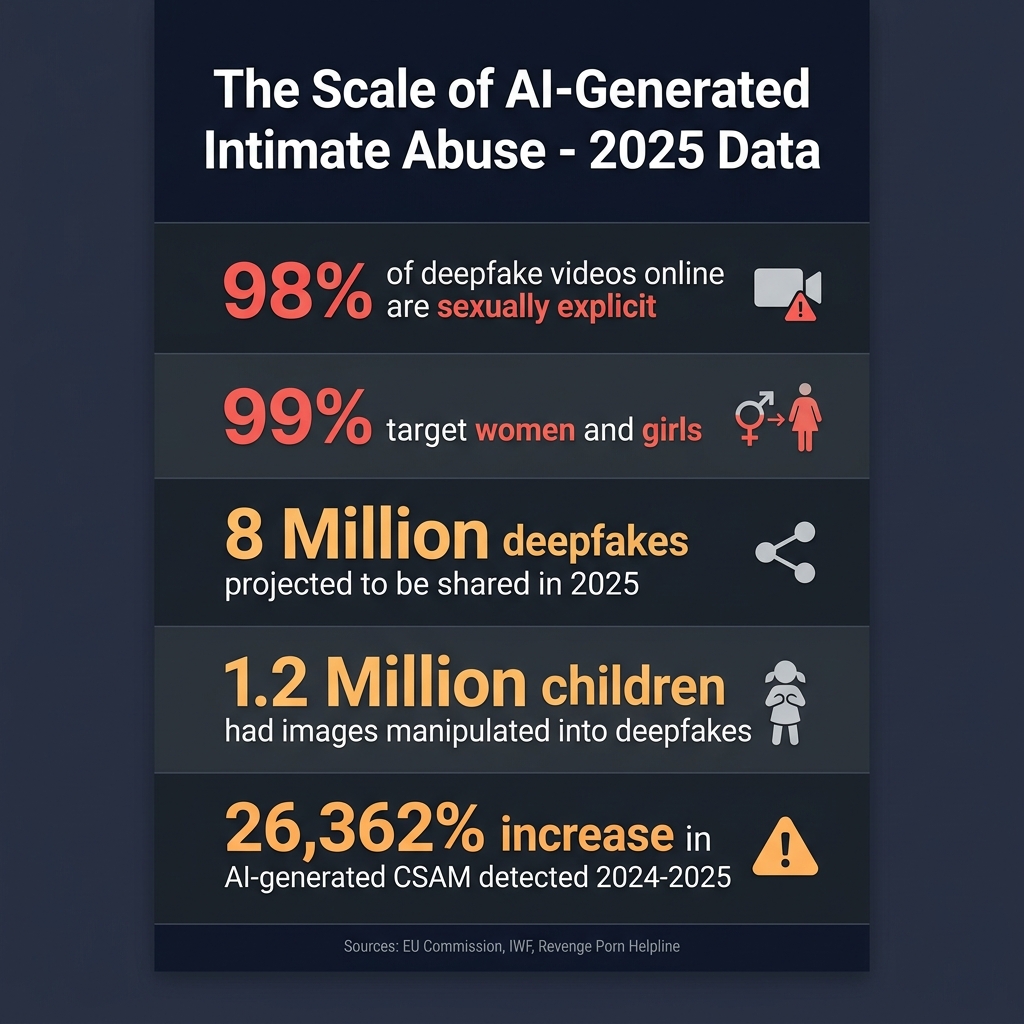
Let us be precise about what these numbers mean:
98% of deepfake videos online are sexually explicit. This figure, documented by the European Commission and corroborated by multiple independent researchers, tells us something fundamental: the deepfake ecosystem was not built for political satire or entertainment. It was built, and is primarily used, for sexual exploitation. Every infrastructure investment in deepfake detection, watermarking, and content moderation must be understood through this lens.
99% of these videos target women and girls. This is not a neutral technology distributing harm equally. It is a gendered weapon. The entire functional architecture of the non-consensual deepfake ecosystem is built to exploit the social and psychological vulnerability that women and girls face when their sexual images are distributed without consent — the shame, the career consequences, the social ostracism, the sextortion leverage.
8 million deepfakes projected to be shared in 2025 — up from approximately 500,000 in 2023. This is a 16-fold increase in two years, driven directly by the democratization of generative AI tools. The barrier to creating a convincing deepfake pornographic video of a real person dropped from requiring a specialist with months of time to requiring a consumer laptop and 30 minutes of freely available software.
1.2 million children across 11 studied countries disclosed in a 2026 report that their images had been manipulated into sexually explicit deepfakes in the prior year. These are not abstract statistics. These are children — primarily teenage girls — who are attending school while knowing that synthetic sexual images of them exist and are being circulated by their classmates.
A 26,362% increase in AI-generated CSAM detected by the Internet Watch Foundation (IWF) between 2024 and 2025. This is not a percentage that fits comfortably in analytical language. It represents an explosion so rapid that existing detection and removal infrastructure — designed for a different era of child sexual abuse material — is structurally overwhelmed.
Part 3: The Cases — From Celebrity to Classroom
Aggregate statistics can obscure the human reality. The following documented cases ground the data in specific, verifiable harm:
The Taylor Swift Incident (January 2024)
In late January 2024, AI-generated sexually explicit images of Taylor Swift — one of the most recognizable and protected public figures in the world — spread across X (formerly Twitter) and Telegram with catastrophic speed. A single image accumulated 47 million views before removal. X temporarily blocked all searches for her name.
The significance of this incident is not that it happened to a celebrity. The significance is the operational lesson it taught: even the most-resourced, most-visible person in the world had no effective technical or legal mechanism to stop this from happening, or to meaningfully remediate it once it did. If Taylor Swift's legal team cannot protect her, what recourse does a 17-year-old student in Busan have?
The South Korean School Crisis (2024–2025)
In August 2024, South Korea revealed the existence of large-scale Telegram networks in which male students were creating and distributing AI-generated sexual videos of their female classmates, teachers, and in some cases, family members. One Telegram channel had over 220,000 subscribers. Critically, 80% of the apprehended suspects were minors — teenagers using consumer AI tools.
The psychological consequences were severe. Surveys found that approximately 75% of students felt anxious about being targeted, rising to nearly 86% among female students. So-called "victim maps" circulated online, listing schools where targeted students attended — transforming entire school communities into environments of fear and surveillance.
This crisis revealed something that should disturb every policymaker and technologist: the primary perpetrators of deepfake sexual abuse are teenagers. This is not a story of sophisticated criminal networks. It is a story of what happens when powerful image synthesis tools meet adolescent social dynamics and zero digital ethics education.
Sextortion at Scale
A less-publicized but pervasive use of AI-generated NCII is sextortion: using synthetic sexual images of a real person as leverage for extortion. Perpetrators — often organized crime networks — use AI to generate fake explicit images, send them to the victim, and demand money or additional real images under threat of sharing the fake ones. The National Center for Missing & Exploited Children (NCMEC) in the US documented a significant increase in sextortion cases involving AI-generated imagery through 2024–2025.
Part 4: The Technology — Why This Problem Will Get Worse, Not Better
The technical trajectory of generative AI models is not favorable to victims.
The Detection Arms Race Is Already Lost
Current human detection rates for deepfakes sit at approximately 24.5% in controlled studies — meaning the average person correctly identifies a deepfake less than a quarter of the time, even when told they may be looking at one. AI-powered detection tools exist but face a fundamental structural problem: they are trained on known deepfake generation methods, and are consistently outperformed by new generation techniques. It is an arms race where the defenders will always be one cycle behind.
The "Liar's Dividend"
The proliferation of deepfakes creates a second-order harm that is almost as damaging as the direct abuse: the "liar's dividend." Because synthetic evidence now exists and is known to exist, real evidence can be dismissed as fabricated. Perpetrators of genuine abuse — sexual, domestic, political — can now claim that authentic video or audio evidence against them is a deepfake. Courts, employers, and the public are left with a fundamentally degraded ability to establish what is real.
Infrastructure Erosion: Biometric Security at Risk
Financial institutions and government agencies that use facial recognition for identity verification have begun to document large-scale compromises using synthetic identities. Deepfakes are being used to defeat KYC (Know Your Customer) verification at banks, to impersonate executives in multi-million dollar wire fraud schemes (a practice known as "CEO deepfake fraud"), and to bypass government identity systems. The same technology serving the non-consensual pornography crisis is also eroding the security infrastructure of the global financial system.
The Zero-Cost Problem
The cost of generating a convincing sexually explicit deepfake of a real person is now, effectively, zero. Open-source models run locally on a consumer laptop. No internet connection required. No account to trace. No payment record. No company to serve a takedown notice to. The economics of harm have inverted: creating abuse is free; remediation costs the victim enormous amounts of time, money, emotional capital, and frequently fails anyway.
Part 5: The Law — What Has Been Done, What Remains Broken
United States: The "Take It Down" Act (Signed May 19, 2025)
The Take It Down Act represents the most significant US federal legislative response to date. It criminalizes the knowing publication of non-consensual intimate imagery — including AI-generated synthetic imagery — when intended to cause harm. It also creates a mandatory takedown obligation for online platforms: upon notice from a victim, platforms must remove content within 48 hours.
By April 2026, the first federal conviction under the Act was recorded in Ohio. The Act is meaningful, but its 48-hour takedown window is still inadequate given that viral distribution can reach tens of millions of people within hours. And it offers no recourse against open-source model operators who have no platform to serve notice to.
United Kingdom: Crime and Policing Act 2026
The UK's Crime and Policing Act 2026 (Royal Assent: April 29, 2026) explicitly criminalizes the creation, adaptation, or supply of "CSA image-generators" — AI models specifically optimized to produce child sexual abuse material — as well as tools used to create deepfake intimate images more broadly. Existing laws (Protection of Children Act 1978, Coroners and Justice Act 2009) already covered digital "pseudo-photographs"; the 2026 law closes the method-of-creation loophole.
India: POCSO, BNS, and the IT Rules 2026
India's legal landscape is a patchwork of applicable statutes. Section 67B of the IT Act covers online publication of sexually explicit material involving children. The POCSO Act 2012 applies to visual depictions of child abuse, with courts increasingly ruling it covers AI-generated material. The Information Technology (Intermediary Guidelines and Digital Media Ethics Code) Amendment Rules 2026 mandate that intermediaries remove unlawful "synthetically generated information" within strict timelines.
However, India lacks a dedicated deepfake criminalisation law — something that civil society organizations and legal scholars have been actively campaigning for. The absence of explicit criminalization of adult deepfake pornography (as opposed to CSAM) remains a significant gap.
The Global Legal Deficit
Despite legislative progress, critical structural gaps remain globally:
| Jurisdiction | Adult Deepfake NCII Criminalised | AI-CSAM Explicitly Criminalised | Platform Removal Obligation | Open-Source Model Liability |
|---|---|---|---|---|
| United States | ✅ (Federal, 2025) | ✅ | ✅ (48hr) | ❌ No |
| United Kingdom | ✅ | ✅ (2026) | ✅ (Online Safety Act) | ⚠️ Partial |
| European Union | ⚠️ Varies by member state | ✅ | ✅ (DSA) | ⚠️ AI Act (risk-based) |
| India | ⚠️ No specific law | ✅ (POCSO + IT Act) | ✅ (IT Rules 2026) | ❌ No |
| Most of Global South | ❌ | ❌ | ❌ | ❌ |
Part 6: The Psychological Reality — What Happens to Victims
Academic research and survivor testimony consistently describe a profile of harm that is comparable in severity to physical sexual violence. Victims of NCII report:
- Severe anxiety and PTSD from the permanent uncertainty of not knowing where their images exist, who has seen them, or whether they will resurface
- Social withdrawal and isolation driven by shame and fear of exposure in professional or family contexts
- Career and academic disruption — documented cases of women abandoning professional social media presence, quitting jobs, leaving educational programs
- Sextortion compliance cycles — where victims comply with extortion demands (money or additional real images) to prevent distribution, which in practice rarely stops the perpetrator
- Suicidal ideation documented in multiple victim support studies
The critical insight from victim research is this: the harm of non-consensual intimate imagery does not depend on the synthetic nature of the image. A deepfake causes the same psychological, professional, and social damage as a real non-consensual intimate image. The victim cannot "prove" to their employer, their family, or their community that the image is fake. And even if they could, the damage of having it circulated is identical.
Part 7: What Needs to Happen — A Structural Analysis
The deepfake pornography crisis is not solvable by any single intervention. It requires simultaneous action across five domains:
1. Platform Responsibility Must Be Hardened
The current standard — wait for a victim to file a complaint, then review and (maybe) remove — is catastrophically inadequate. Platforms must be required to:
- Proactively detect and remove NCII using AI classification tools before content is published
- Verify the consent of all people depicted in explicit content before publication (the "FOSTA-SESTA" model, extended to synthetic imagery)
- Maintain technical infrastructure (hashing, digital watermarking, C2PA content provenance standards) that allows synthetic content to be identified across the open web
2. Open-Source Model Responsibility Is an Unsolved Problem
The most urgent, most technically difficult, and most philosophically contested challenge in AI governance is the question of open-source model liability. When a model capable of generating CSAM or NCII is released under an open-source license and downloaded by millions of users, existing legal frameworks have no coherent mechanism to assign responsibility. This requires genuine international cooperation and a new legal concept — perhaps a "design defect" standard analogous to product liability law.
3. Digital Literacy Must Be a Non-Negotiable Educational Priority
The South Korean school crisis revealed that teenage perpetrators often do not understand the severity of what they are doing. Digital ethics, consent, and the legal and psychological consequences of NCII must be mandatory curriculum elements — not optional modules — in secondary education globally.
4. Victim Support Infrastructure Must Be Funded
Organizations like the Revenge Porn Helpline, StopNCII.org, and the Cyber Civil Rights Initiative provide critical support to victims — from content removal requests to legal referrals to psychological support. These organizations are systematically underfunded relative to the scale of the crisis they address. Government and platform funding obligations should be legally mandated.
5. The Right to Digital Integrity Must Be Recognized
Ultimately, the legal and philosophical framework required is a "Right to Digital Integrity": the recognition that an individual's likeness — their face, voice, and body — is their own sovereign property, and that its use without consent in any context, including synthetic recreation, is a violation that the law must protect against. Several EU member states are beginning to move in this direction. It needs to become a universal standard.
The LensCraft Research Perspective
At LensCraft IT Ventures, we research technology at its hardest intersections — where technical capability outpaces legal, ethical, and social frameworks. The AI deepfake pornography crisis is, from a research perspective, one of the clearest examples of what happens when transformative generative technology is deployed into a regulatory vacuum with no proactive harm mitigation.
The same diffusion model architectures that power legitimate creative tools, medical imaging AI, and design applications are, in their open-source forms, primary instruments of sexual violence. This is not a hypothetical risk. It is a documented, ongoing crisis affecting hundreds of thousands of real people — disproportionately women, disproportionately young, disproportionately without legal recourse.
The technology industry — which built these models, hosted these platforms, and profited from this ecosystem — bears a specific and non-negotiable responsibility to be part of the solution. That means mandatory content provenance standards (C2PA), proactive harmful content detection, platform liability reform, and sustained investment in victim support infrastructure.
It also means that the AI research community must grapple with a question that has been conspicuously absent from most academic AI ethics discourse: when open-source model release demonstrably enables mass sexual abuse, does the philosophical commitment to open access override the human cost?
The answer to that question will define whether the AI field is capable of governing itself — or whether government regulation, however blunt, becomes the only available response.
Sources and References:
- European Commission — Digital Services Act Research, 2024
- Internet Watch Foundation (IWF) — Annual Report 2024–2025
- Revenge Porn Helpline — Statistics 2024
- Human Rights Watch — South Korea Digital Sex Crimes Report, 2024
- US Take It Down Act (Pub. L. 119-xx, Signed May 19, 2025)
- UK Crime and Policing Act 2026 (Royal Assent April 29, 2026)
- India IT (Intermediary Guidelines) Amendment Rules 2026
- NCMEC — CyberTipline Data 2024–2025
- Cyber Civil Rights Initiative — Victim Impact Research
- StopNCII.org — Resource and Reporting Platform
If you or someone you know has been affected by non-consensual intimate imagery, contact: 🇮🇳 India: Cyber Crime Helpline — 1930 | cybercrime.gov.in 🇬🇧 UK: Revenge Porn Helpline — 0345 6000 459 | revengepornhelpline.org.uk 🌐 Global: StopNCII.org (Image Hash Removal Tool)